Heat pump replacement · Auckland
Heat pump replacement and system upgrades
The floor loops and manifold stay. Most replacements take one day.
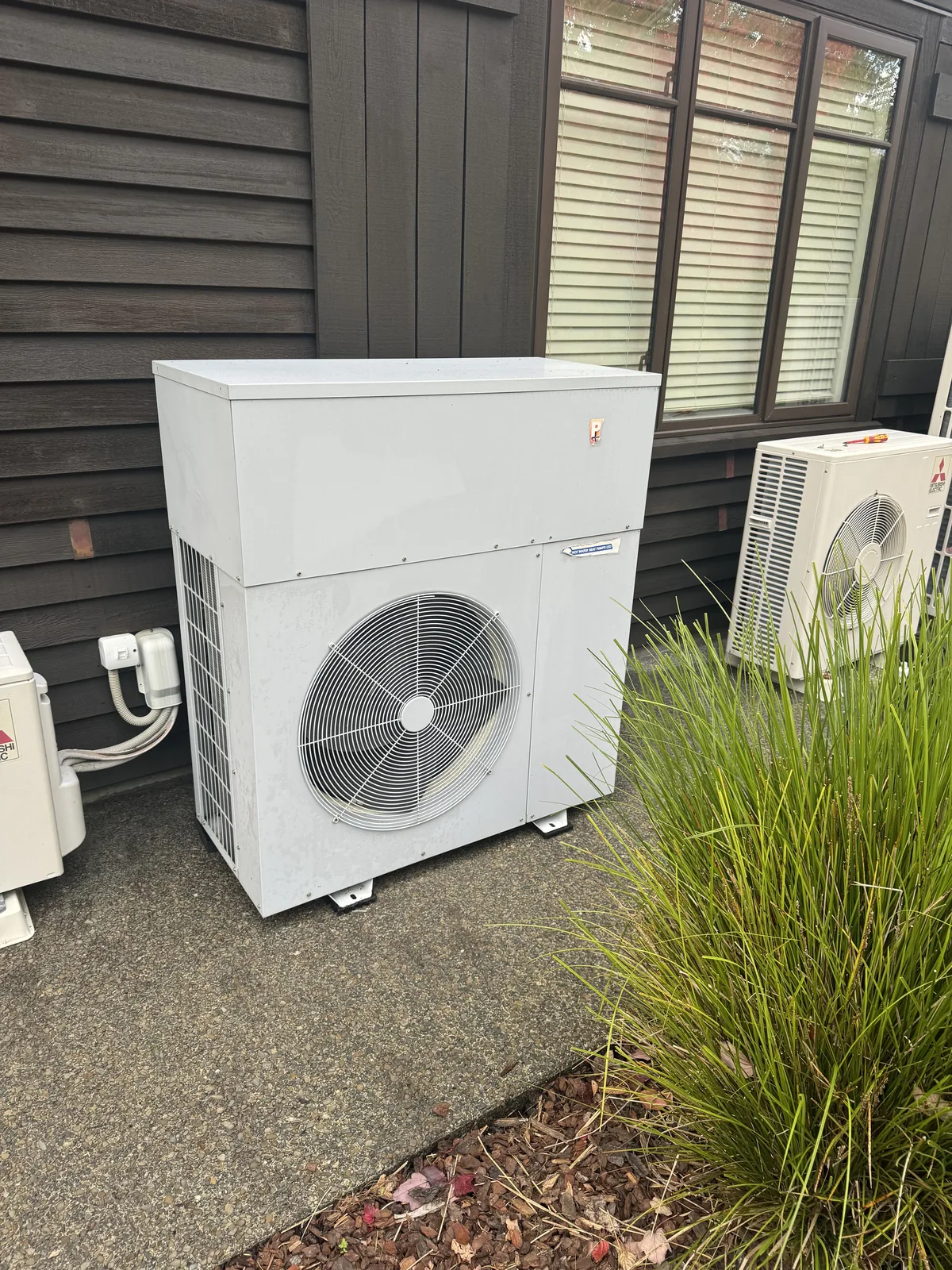
A hydronic heat pump is an outdoor unit connected to your system by two pipes and a cable. When it reaches the end of its life, typically around fifteen years, only the outdoor unit is replaced. The pipework in the floor stays as it is.
What we do
Replacing a heat pump, or upgrading to one
We decommission and degas the existing unit, dispose of it, and replace it with a new heat pump.
We also upgrade existing systems to a heat pump, for example replacing a diesel boiler with a heat pump. This is work we do often, and it can often be done in one day.
What is needed:
- An electrician on site to provide power to the new heat pump location.
- A concrete pad for the heat pump to sit on.
- A route for two pipes from the manifold location to the new heat pump location outside, through walls, floors or the loft space.
The day
The replacement process
Check what is there
The pipe run, its insulation, the pad or brackets, the electrical supply, the manifold and the condition of the system water. Plus a heat loss calculation, so the new unit is sized for your house today rather than for whatever was fitted years ago.
Old unit out
Isolated, drained, disconnected and removed, with the refrigerant recovered properly by somebody licensed to do it.
New unit in, same connections
Onto the existing pad or brackets where they are sound. Flow and return reconnected, pipe insulation made good, electrical checked and reworked if needed.
Commission and balance
Flow temperatures set for a slab rather than left at a factory default, every zone checked, controls configured, and you shown how to run it. Commissioning has a large effect on running cost.
Fast and efficient, Tony replaced our old system and got us back on within 24hrs of install. Highly recommended.
What we fit
Performance Plus heat pumps
Built in New Zealand by Hot Water Heat Pumps Ltd, in the widest underfloor range available in Australasia, so a replacement unit can usually be matched to the existing space and duty.
Built here, supported here
Engineered and assembled in New Zealand, with parts and technical support in the country.
Buffer and pump built in
The ‘Ub’ models carry the buffer tank and circulation pump inside the unit, which on a retrofit often means less to find space for in the cupboard and a tidier swap.
Size range
10, 12 and 17 kW single phase, more in three phase, inverter models above that. The size steps let us match the unit to the house.
Noise level and winter performance
53–56 dB(A) at three metres, epoxy-coated coils for coastal Auckland air, and electronic reverse-cycle de-ice so it keeps working on a cold damp morning.
DuoHeat — do more than before
One unit for floors plus pool, or floors plus hot water. Allowing for either is cheapest at the time of replacement.
Steady temperature control
Maintains a set temperature in all weather rather than cycling on and off, which is the main efficiency gain over an older fixed-speed unit.
Questions
Heat pump replacement questions
My heat pump has failed. Do I need a whole new system?
Usually not. A hydronic system has three parts: the loops in the floor, the manifold and controls, and the outdoor unit that heats the water. The outdoor unit is the part that wears out. The loops are cast in concrete and do not degrade; the manifold, valves and thermostats are usually fine or can be replaced individually.
How long does a heat pump replacement take?
Most of them are a day. Old unit off, new unit onto the same pad or brackets, flow and return reconnected, electrical checked, controls set up, system balanced and commissioned. Where it takes longer is when the new unit is a different size or shape, when the old pipework is corroded, or when the electrical supply needs rework.
Can you reuse the existing pipework and pad?
Usually yes. We check the pipe condition, the insulation and the pad or brackets first, and price any replacement that is needed.
When should a heat pump be replaced?
As a rule of thumb, once a unit is past about twelve to fifteen years and needs a major component — compressor, heat exchanger, control board — you are usually better off replacing it. Under that, repair is often the right answer and we will do the repair.
Will a new one cost less to run than the old one?
Generally yes. Efficiency has improved, and newer units have inverter compressors that modulate instead of cycling on and off, better defrost control, and controls that match the flow temperature to the weather. An old fixed-speed unit starts and stops frequently, which reduces its efficiency.
What is the Performance Plus range?
The New Zealand-built range from Hot Water Heat Pumps Ltd — the ‘U’ series for underfloor heating, from 10 kW to 28 kW and beyond, with single-phase and three-phase options, and DuoHeat models that do floors plus pool or floors plus hot water from one unit. Built in New Zealand, supported here, with parts here.
What is the difference between a ‘U’ and a ‘Ub’ model?
A ‘Ub’ has the buffer tank and circulation pump built into the unit. A ‘U’ does not, so those are separate. On a replacement, the built-in version often makes the swap tidier and quicker — fewer things to find room for in the cupboard.
Can the new one do more than the old one did?
Frequently, and this is worth asking about before you order like for like. A DuoHeat unit can heat your floors in winter and your pool in summer, or your floors and your hot water cylinder all year. If you were ever going to add a pool or move hot water off an element, the moment you are replacing the heat pump anyway is the cheapest time to make it possible.
Do I need a bigger unit than I had?
We will not know until we have done the heat loss calculation, and the answer is often no. Houses get insulated, windows get replaced, and the original unit may have been oversized. Sizing from the old unit can result in a larger unit than the house needs.
Is it noisy?
Modern units sit around 53–56 dB(A) at high speed measured at three metres, and inverter models spend most of their time well below that. Position matters more than the number — not under a bedroom window, not boxed into a corner with no airflow.
What if my old unit is a different brand?
That is not a problem. We replace units of every brand and are not tied to one. The replacement is sized for your house, and the pipework it connects to is checked first.
Installed and running
Free, no obligation
Send us a photo of the unit and its badge.
The model plate on the side tells us most of what we need. From that and the size of your house we can usually tell you what the replacement involves without a site visit.