Laing electric boiler · Auckland
Replacing a Laing electric boiler
Service, repair, or swap it for a heat pump — the floor loops stay exactly where they are.
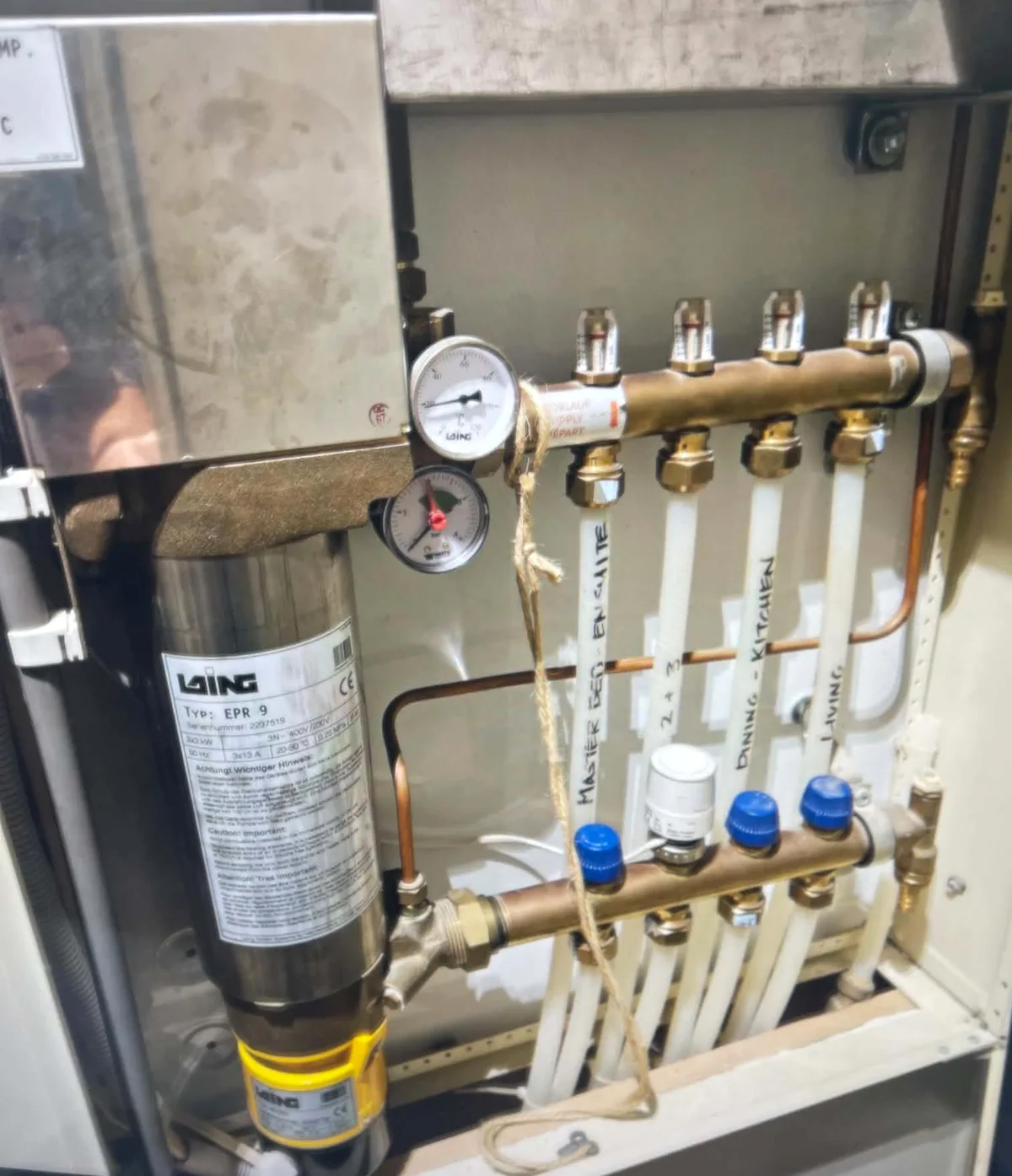
If there is a slim white cabinet in your cupboard with LAING on the front, you have an electric boiler feeding your underfloor heating. We service them across Auckland. It uses an electric element, so every kilowatt of power you buy becomes one kilowatt of heat. A heat pump on the same floor loops delivers about four. The calculator below shows the difference in running cost.
Move the slider
Running cost comparison
Pick your element size — it is on the label inside the cabinet, and it is almost always 3, 6 or 9 kW — then set roughly how many hours’ worth of heat it delivers on a winter day. Every assumption is shown and every one of them is editable.
Power price 39c/kWh is the national average from MBIE’s Electricity Cost and Price Monitoring, February 2026 (Auckland sits around 37–40c). “Hours at full output” means equivalent full-load hours — your boiler cycles on and off rather than running flat out, so use the number of hours’ worth of heat you think it delivers, not the hours the system is switched on.
The swap
What changes
Replacing the boiler does not mean replacing the heating. The pipe in your floor, which cost the most and lasts the longest, stays as it is.
Swipe sideways to see the whole swap →
The element comes out
The Laing element and its circulation pump are removed from the cabinet. The electrical supply that fed it is reworked — a heat pump needs considerably less of it than a 9 kW element does.
The manifold stays and is adapted
Your existing manifold — the bar with all the loop connections on it — is what feeds the floor. In most cases it stays exactly where it is. We adapt the connections, add what the new plant needs, and leave the loops alone.
Two pipes go out through the wall
A flow and a return, insulated, from the manifold through the external wall to the heat pump outside. That is the whole of the new pipework, and on most houses it is a short run.
Heat pump, controls, commission
The unit goes on a pad or brackets outside. Controls are set up, every loop is balanced, the system is tested, and we show you how to run it.
Still working, or stopped?
We do both jobs
Keeping your Laing going
We service Laing systems across Auckland every week and we carry the parts that usually fail. If a repair is the sensible answer, we will do the repair.
- Circulation pumps and pump replacement
- Zone valves, actuators and thermostats
- Air in the loops, pressure loss, cold rooms
- Element and contactor faults
- Rebalancing a system that has never been set up properly
Swapping it for a heat pump
The loops and manifold stay and the element is removed. The floor heats the same at roughly a quarter of the running cost, with the option of hot water and pool heating from the same unit.
- Room-by-room heat loss before we size anything
- Fixed price, including the electrical rework
- Usually a short job
- Hot water cylinder can be added to the same heat pump
- Pool can be added for summer, when the floors are off
Questions
Laing boiler questions
What is a Laing boiler?
A Laing electric boiler is a wall-mounted panel — usually a slim cabinet in a cupboard or laundry — containing an electric element, a circulation pump and the manifold that feeds your underfloor heating loops. Thousands of Auckland houses built from the 1990s onwards have one. It is reliable, but heating water with an electric element is the most expensive method.
Why is my Laing system so expensive to run?
Because an electric element turns each kilowatt of electricity into one kilowatt of heat. A heat pump moves heat from the outside air into your water, delivering roughly four units of heat for each unit of electricity — roughly a quarter of the running cost for the same heat.
Do you have to break up my floor?
No. The pipe loops cast into your slab are the expensive part of a hydronic system and they do not wear out. They stay where they are. So does the manifold, in most cases. Only the heat source changes.
What happens on the day?
The Laing element and its pump come out of the cabinet. We adapt the existing manifold, then run a flow and a return pipe from that manifold out through the wall to a new heat pump sited outside. The power supply is reworked — usually a smaller supply than the element needed. Then we commission and balance the system and show you how to run it. On a straightforward house it is a short job.
Where does the heat pump go?
Outside, on a concrete pad or wall brackets, with clear air around it and access for servicing. It should be a reasonable pipe run from the manifold and not under a bedroom window. We decide the position on the site visit.
Will the floor still get as warm?
Yes. Underfloor heating runs at low water temperatures, which is where a heat pump is most efficient. Radiators on the same system need checking, because they were probably sized for hotter water.
Is it worth doing if the Laing is still working?
A working Laing costs roughly four times as much to run as a heat pump for the same heat. Use the calculator above with your own numbers. For most households the saving over a few winters is more than the cost of the swap.
My Laing has stopped working. Should I repair it or replace it?
It depends what has failed. A pump or a thermostat is a straightforward repair and we will do it. If the element itself has failed, or the panel is old enough that parts are hard to get, replacing it with a heat pump is usually better value. We will price both, side by side, and let you decide.
Do you still service Laing systems?
Yes, every week. Pumps, actuators, zone valves, thermostats, air in the loops, pressure problems.
What about hot water and the pool?
Once there is a heat pump outside, both become options. The same unit can be arranged to heat a cylinder, and in summer — when the floors are off — a pool. Hot water is used every day of the year, which improves the payback.
Is there a rebate or a subsidy?
Programmes change over time. Ask us when we quote and we will tell you what is available at the time.
Champion Heating is an independent heating contractor and is not affiliated with, endorsed by, or an agent of Laing. The name is used only to identify the equipment we service and replace.
Free, no obligation
Send us a photo of the cabinet.
Snap the label inside the door and email it over. From the element size and the size of your house we can tell you what the swap involves and what it would save, usually without a site visit to start with.